
ESP KH-4 Kirk Hammett limited edition

His own
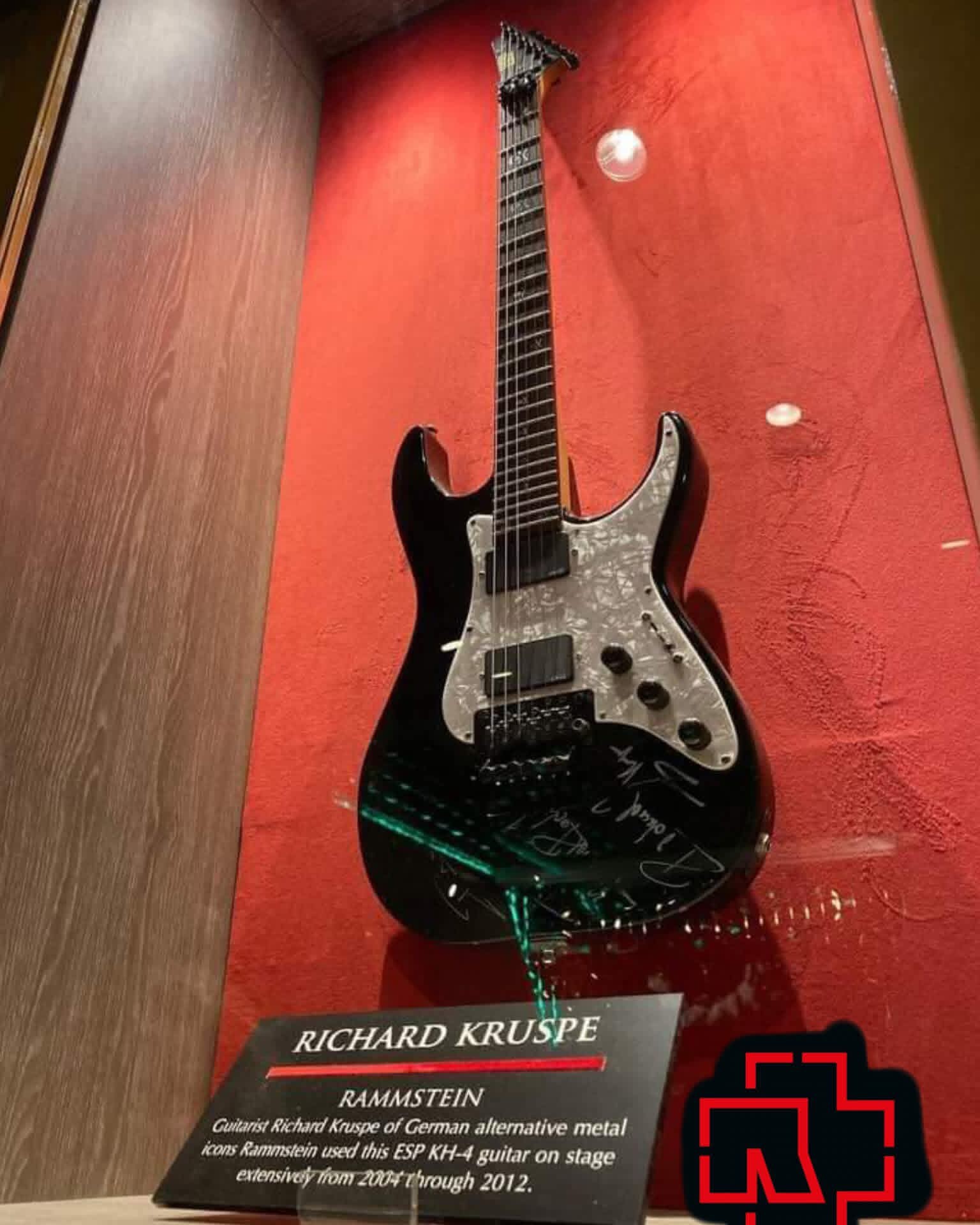

ESP Akauzu Kun signature see-through red, was chosen for him by Jason. J+Q needed at least one artist to test a scroll shape guitar on a stage. Or Ha would have to guitar with rubberbands wrapped here and there on her Strat guitar, she and Jason joked one time about her guitar.
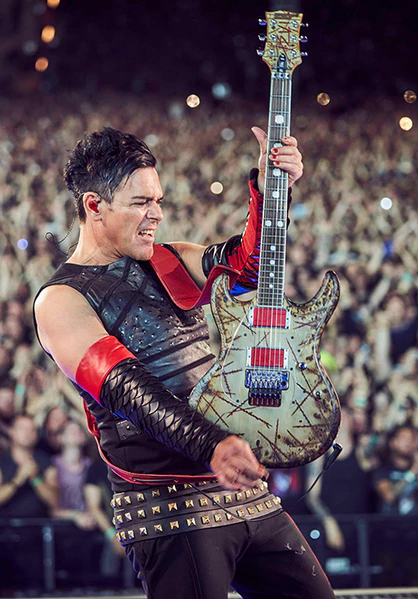
2019 European Stadium Tour. ESP RZK-I with signature EMG red humbuckers. Rgo's untilted assymetric “Ouija” bodyshape with modestly fat bottom, paired with Jason's unique pickguard for Richard, was codenamed “Riskee Koochie”, so the folks in Japan would not forget their standby folio for him.
 | ||
|
“Close your eyes, there are two clowns there,” Ha to ESP, who were scouring rgoDark for artists to join them on the project. According to Mexican Metal magazine Summa Inferno, by 2025 Richard is the first European to have a full line of ESP guitars. How does one weigh that versus Paul, the first German with a signature Gibson Les Paul? Equal? Ha says Richard pulled ahead by quitting on the gold-trimmed ESP Eclipse. Only means she'll have to rig something for Paul, and it might not be ESP or Gibson.
| ||


The natural strum position on the 1990 Gibson Les Paul (top, Custom) is 2nd position, the center of gravity, even low-slung on Paul. Jason consulted Ha on very small tweaks for either one. They kept the ESP bridge slant at whichever degree angle it was already, which was less steep than the Gibson. The placement of the switch should be centered with the outer curve and aligned for the body on the ESP, said Ha, On the Gibson it is only aligned for the body. That moved the center of gravity up towards the neck about one inch to 3rd position, which could use picking up the guitar to tilt upward instead of kept relaxed by a Rhythm specialist like Paul, adjusted for Richard. Was that appropriate? Strumming in the back two positions towards the bridge is for parlour exercises in Flamenco, Country, Rhythm and Blues, some Jazz. Richard is not completely blind in his right hand, he takes his time to develop his Lead style. Yes, Richard can do two scales of strings different from Dimebag Darrel, Ha confidently told Jason. Show [to] me, he wanted.
Ha restrung the bottom four strings on her guitar. All Jason had to do was estimate in his head whether Richard's strings would have problems on the TellMeMore, not the Stratocaster MeinTeal, regardless which guitar manufacturer came Richard's way, even outside Rgo's catalogue of OEM lutheries. Jason specified 3+3 wound and bare steel. Ha said it should be like acoustic guitar standard at the time, 4+2 for Lead guitar. Perfect. They had to spread out two scales for range differentiation so there is no duplicates among Rgo clients. If guitarists add the four string sets together, Jason was happy that would cover all the Metal guitaring they would ever use. But it is not Industrial, Ha added. Okay, she deflated his momentary happiness. Sigh. So it is not Punk. Smack!
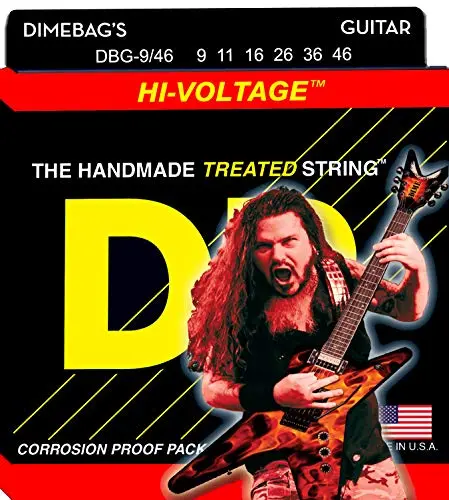

Dimebag Darrell's 1995 DR Strings Hi-Voltage signature sets are 9-46 and 9-50. Two more sets were added to help string his Dean Dimebag Razorback 7 255, a 7-string guitar he designed but never got to play; he was murdered while performing on-stage in December 2004. The DR Strings 10-46, 10-52, and Heavy 11-50 were also added to Dimebag Darrell signature line.
These are the string gauges Jason and Ha separated out for Dimebag/DR and RZK/SIT strings up to Dimebag's preferred Dean 7-string guitar without changing the upper limit at 0.050 to 0.052 inches. The range was a compromise with Jason, which do not include Ha's Rgo (noncommercial) gauges for all guitars up to 12 strings sympathetic and all the wide ones up to 8 strings, plus the acoustic guitars and lap steel and bass guitars, all lutes of that axis such as mandolin, banjo, ukelele, allowing for rubber strings but not headless guitars. Modern electric guitar from the 1960s to today tends to use strings in gauges twice thinner than Ha's stringing style, from the same manufacturers with nothing new in strings manufactured by Rgo. How is that possible?
| Dimebag Darrell DR Signature |
Richard Z Kruspe S.I.T. Signature |
Q Rgo 4rzk 2009 compressed* + 2026 SITulele |
|||||
| 9-46 | 10-46 | 9-50 | 11-50 | 10-46 | 9-50 | 13-42 | 18-66 |
| 9 11 16 26 36 46 |
10 13 17 26 36 46 |
9 11 16 28 38 50 |
11 14 18 28 38 50 |
10 13 17 26 36 46 |
9 13 17 26 36 50 |
13 19 23 24 33 42 |
17/19* 26 36 46 56 10+56* |
*The 2009 1+3+2 “compressed” range is for Richard's natural vocal pitch range for guitaring Divo, which might be annoying or relaxing to match one's guitar range to one's usual vocal range. Till can growl ontop of his own natural Divo in the Alto register, while Richard's Divo is broader from Alto to messo. However, Till's vocal range is quite larger, and his natural conversational register is actually Divo with the wind but not indoors and not so often in concert, light like Paul's, which is ideal for Richard. The absurd single string on top is compensated with greater warmth and easier control, since Richard is not flashy as a Lead singer or a Lead guitarist. A gauge of 0.019 inches (0.43 mm) is achieved by twisting two existing strings together in Richard's Signature S.I.T. sets, the 9 and 10, approximating 17, 18, or 19 gauge. There are 2-5 twists: centered twist at hand strum and center of frets evenly spaced, for example, 4th fret, 13th fret, and 2nd position strum hand below center between pickups. The 66 gauge is achieved the same way, depending on the desired texture of the twisted strings. 10 is recommended to mimic nylon acoustic that can take the abuse of a jagged metal pick (Ha's). A 56 gauge string comes from a bass strings set. 26+36 already exists without badgering poor Oli, = 62, which is close enough to stay in tune for the Rgo Rammstein Rumble. Hammering on one side of the pick with a near stop motion, like pizicato or mimicking hammering inside a piano—rather than plucking like a harpsichord or thumping with the thumb for slaps and pops—is the technique preferred for the lone lower string that can now be tuned to Baritone register, which was introduced with the tightly clustered middle strings in the Compressed range set in Contra-alto to Soprano.
Oli's strings are presumed 45-105, GDAE, but he tuned them higher than a bass4 guitar for the Stadium Tour. The matching range for Oli on bass6 and Richard's could be 32-135, CGDAEB. Two octaves higher is Rammstein's latest “Drop C” on the guitar. There is no such thing as drop anything while playing guitar, except Ha lies, because she does drop her pick when bored with plastic and wifi guitarists. Buch butch butt... buck... a dollar on the ground?
There is no difference whether Ha says Punk is the granddaddy technique or Jason says Metal is the grandma genre sound. He asked politely, What is the difference?
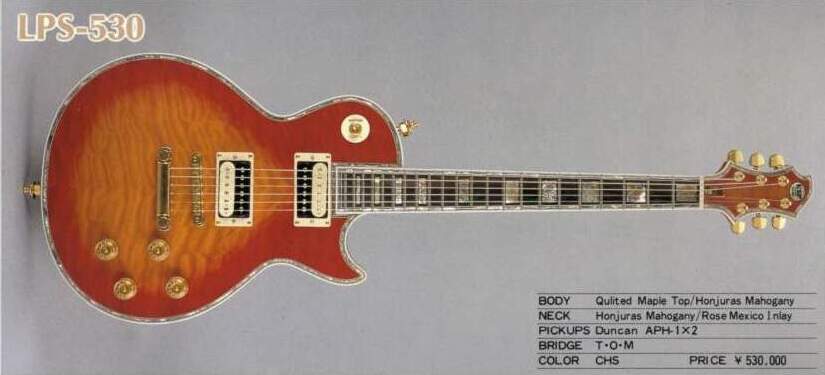
If they could stabilize the ESP Les Paul using guesswork about Richard, plus QA the feel on Ha and the sound on Jason, Ha could keep the Gibson Les Paul folio for a long time. What was there to change on the ESP Eclipse from the 1992 catalogue (shown: ESP LPS 530 [Les Paul Standard])?


ESP RZK-I-test retroactive transition (step backwards) *TEST guitar, between RZK-600 and RZK-I, w/ offset `fatty Red Cross` big fret marker insignia. The uncentered solid `fat cross`, in bluish-purple colour for European fans as an added-value aftermarket deco enhancement, was rejected. The knob and switch were removed from one of those made by ESP, the owner informed Ha, for the price of the sticker-like graphic, $12. Supposedly only a few were made. Source: rgoDark↗ 2009.
Early in production, a blind test was given to an ESP luthier who had career stakes in the craft and is female. If a designer commissioned ESP with a sketchy description of a graphic element, even a proprietary logo like Rammstein's, there tended to be an aversion to copying commercial material, or sometimes the in-house designer would create a hybrid that was not exact. ESP found no fault with their in-house luthier, and neither did Ha.
Rammstein's chief graphic designer, __, also went through a similar test, even though he had been working with the correct logo for some time. Eventually, he did an excellent job rendering the logo in graphic matchsticks, after Ha and rammArt gave him the answer in 2009; rammArt was a good communicator.
The guitar is an after-1993 democratic design decision dissenting upon Rgo. Both the (a) centered “matchsticks” or stencil logo, and the (b) filled Red Cross came up for a vote. In thirty seconds, Jason convinced Ha to agree to his (a) vote, which she did, which was done in 1993. After the vote, the two also agreed that it would be a waste of resources to push ESP through too many design steps. Ha agreed, reserving her expanded tutorial on parliamentary Vote-of-No-Confidence for a later session, which was used during parlaying for the Metallica-owned vinyl records factory in the same town (Alexandria, Virginia).
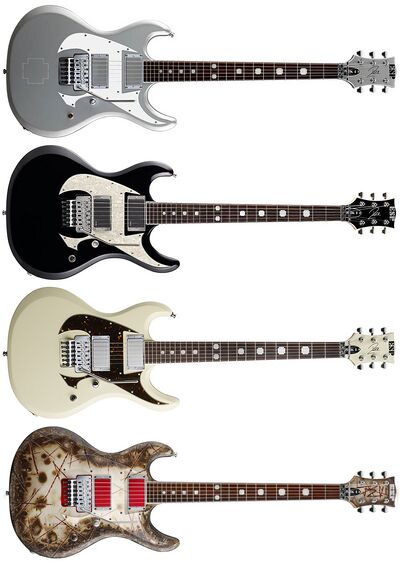
RZK-I “the Jason Rammstein guitar”, by 2012 four colourways are available :
2009 Platinum, originally the __ Black Satin Olympic White {?? vintage white?} Burnt
_____
2009 RZK-I Logo no.1 “Kwayzaar” (Q+rgoDark 2009)
https://www.guitarristas.info/anuncios/esp-rzk-1-signature-platinum-silver/1231185
2012 RZK __
She had worked on Richard's guitars by herself. It was three weeks or so and dragging. She was glad to know everyone on rgoDark, but she was gladder rammArt had not forgotten about her. __
Oli's strings are presumed 45-105, GDAE, but he tuned them higher than a bass4 guitar for the Stadium Tour. The matching range for Oli on bass6 and Richard's could be 32-135, CGDAEB. Two octaves higher is Rammstein's latest “Drop C” on the guitar. There is no such thing as drop anything while playing guitar, except Ha lies, because she does drop her pick when bored with plastic and wifi guitarists. Buch butch butt... buck... a dollar on the ground?
There is no difference whether Ha says Punk is the granddaddy technique or Jason says Metal is the grandma genre sound. He asked politely, What is the difference?
If they could stabilize the ESP Les Paul using guesswork about Richard, plus QA the feel on Ha and the sound on Jason, Ha could keep the Gibson Les Paul folio for a long time. What was there to change on the ESP Eclipse from the 1992 catalogue (shown: ESP LPS 530 [Les Paul Standard])?
He had one of those before deviating from Paul Landers, an ESP Eclipse-I CTM in Vintage Black (third from top), a Les Paul bodyshape on an ESP with gold colour hardware and trim.__yrs It has four knobs like a Gibson one would. It's a Jason guitar: all ESP/LTD guitars with the “flag” fret inlays, codename “falling papers”, were redone or designed from scratch by Jason Guyker. After the 2009 tweak, the Les Paul bodyshape was back in his collection, the RZK-II. What makes an ESP/LTD guitar a Ha guitar? Not the fret inlays for the fans, right?
The E-II BB was started in 2014. The E-II ECLIPSE DB was formerly called the “ESP Standard”, an upgrade to the CTM I. In 2021 ESP renamed the J Rgo guitar in honour of Damon Brent Verner (d.2020), a trained drummer who loved guitar music. Originally codenamed “DB”, for decibels in 1993 by Jason and Ha, the guitar was released as the ESP Eclipse II DB in Vintage Black. In the 1999 era, Brent and Ha built the equivalent of Univac out of an old IBM 286 and her own 1994 Compaq 386 with an AMD 350 MHz chip, and plopped on Linux and GNU tools and K+R compiler with 7 Slackware diskettes using SAMBA from home to mount the Windows NT harddrives of the Digital 64 network supported clustered by Dell in-house at work to have a filesystem served back through Sun plain Sparcs from the production department of an old newspaper company next to Fort Bragg in North Carolina. Ha was a programmer and librarian at the company.
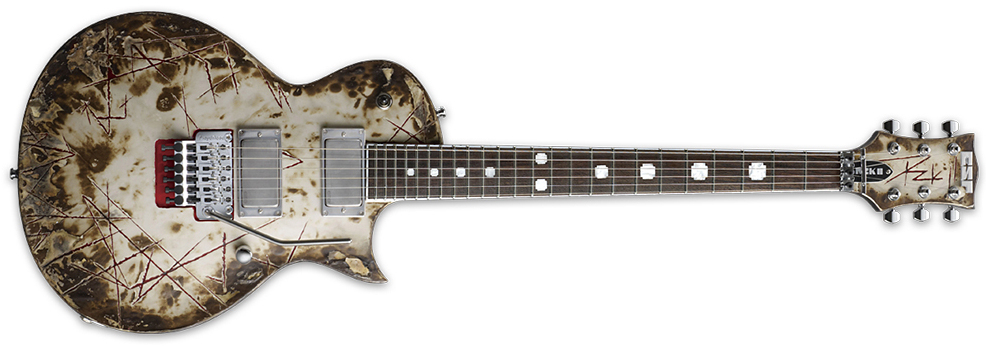

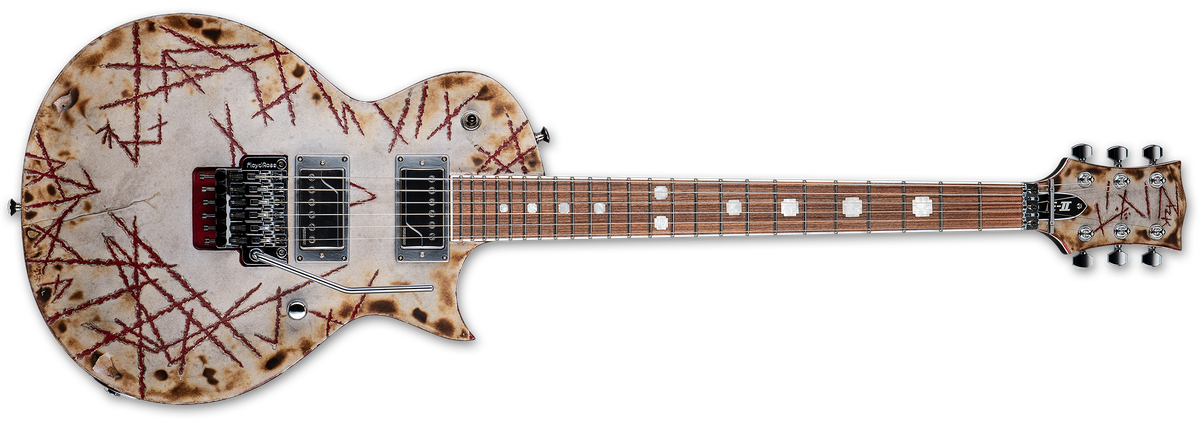
RZK-II is Richard's ESP Eclipse Burnt, 2012 production model (top). It can sometimes burn out to a greenish brown colour. It has the 81/81 EMG pickups in chrome. The saddle plate under the Floyd Rose is red chrome on both of them. However, Richard rarely uses a whammy bar, but it was included for other professional musicians and is capable of Lead guitar awesomeness. The RZK-I ESP E-II Burnt is reddish orange colour (center). For a time there, both Richard and Paul had simplistic control layouts: one button, one switch. A little lighter on tne burn, you can get the E-II RZK-II Burnt in black chrome Fishman Fluence Richard Z signature pickups (bottom). Up to the RZK-III Phoenix, the RZK-I and RZK-II in all their variations are “Ha Fenderized” guitars.
The best average by sound quality, when the entire line of EMG was retested under Rgo back in 1993, is 76. For sentimental reasons, the Americans remember their bicentennial. Japan, Europe, and South America disagreed. They set the average higher at 80/81, and they stopped quibbling which is better. 80 and 81 are actually quite different from one another; the variance is greater and there is a clear jump in style between them, which is why they are muddly when combined. There are dissonant overlaps if they are not matched, because they are active pickups. Ha was pacing back and forth between memos, they would be great as passive pickups: Ha was mute for six months her first year in the USA. The consortium chose 81, the inverse. They sent the 80 to Rgo to redevelop more combined passive pickups.
Some durable EMG combinations are 57/66 (long gain tolerance in the Ritchie Faulkner “Falcon” RF Set), 81/85 sweet spot of modern Rock and mid-Progressive, also great for Metal guitaring (Kirt Hammet's “Bone Breaker” is similar to a Fishman Fluence with a crisper Neck tone using the same alnico 5 and ceramic at the bridge), and the adjusted Fenderized 60/81 (James Hetfield's not-for-fielding in wide open country “Het” Set with the neck pickup of dense core and ceramic poles and bobbins and the bridge pickup with steel poles and bar magnets). See Rgo's explanation of the world's most expensive passive humbucker (Aquasplash) prototyped to be converted into active but not go on a Year1 KH/JH/RZK guitar, so Paul might have to pay double for his last Les Paul on the planet.
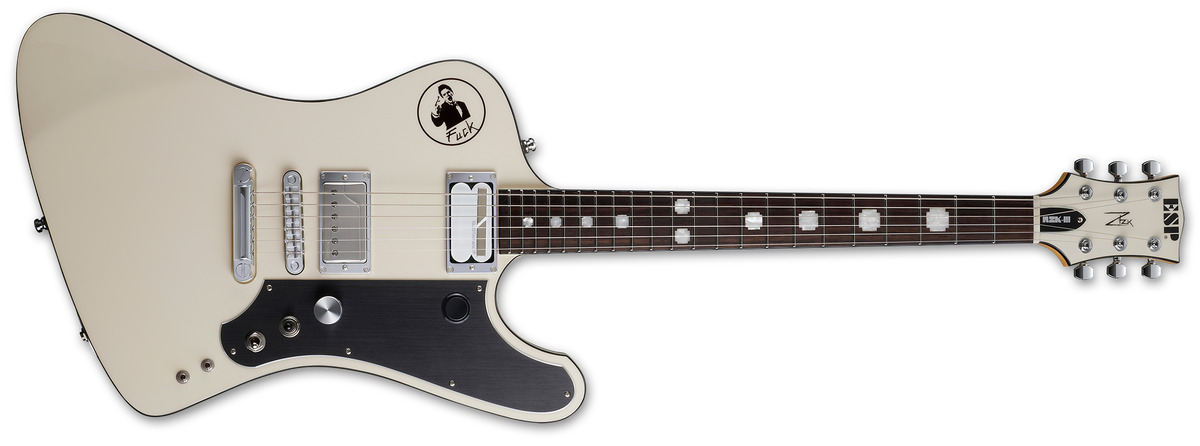
The combined powerhouse of de-Fenderizing by Gretschifying, J no less Q on the ESP/LTD RZK-III signature Phoenix in Olympic White, codename “Fnix Owwie”. Richard's is a custom ESP one before the production model rolled out. At that point, ESP's strategy to lengthen the scale to 25.5 inches, like they did before for lowered tuning to get close to a baritone guitar... was unnecessary. For the first time, Ha received a memo through rgoGrey on Richard's need, c. February 2026, after the changeover from Statty and Lessy bodyshapes. He wants it shorter, which Jason and Ha anticipated. During the improvised song &Ein Eins“, Ha had to overcome lack of bass and drums by going down the keyboard on the left hand on a synthesizer in her head and stopped playing on her bottom two strings to down-tune Jason's guitar into neater baritone range. She strummed on the upper strings afterwards to prompt him into a Lead solo after he could hear the lower string.
Richard has been corporatizing Ha's guitars. Funny how if it's a Jason guitar, he does his compulsories, there are more guitar solos in addition to riffs. Translation: Ha's ESP guitars are only good for riffing. Hold on here. The Gibson Les Paul is only good for rhythm (scratches head). The Malcolm Young Gretsch is only good for Punk grooves (scratches back of neck). What about the Fender Hello Kitty, eh eh? (lets cat scratch chest).

ESP LTD Richard Z. Krupse signature RZK-600 Platinum Silver w/ EMG 81/81.
The Rgo “RAMMYLOGO” guitar included the Rammstein logo for LTD but is optional at no extra cost on the ESP model. At some point, by fan request, ESP/LTD made the logo optional on both models.
https://www.musiciansfriend.com/guitars/esp-ltd-rzk-600-richard-z-signature-model-electric-guitar
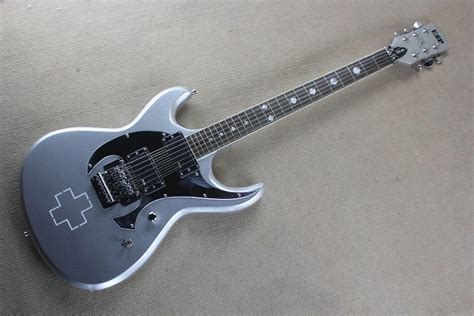
Counterfeit guitar retailed by AliExpress.
The Rgo specification by Jason is his own design, a unique pickguard shape with exactly 13 screws in its first iteration, representing his age the year he became a lutherie apprentice and joined Rgo in 1992. One more screw was added when he decided to add the whammy bar saddle, for a total of 14 screws for his age in that year 1993, before he sent the specifications to LTD first then they to ESP. The cost calculation for the less expensive LTD model was a bottom-up reporting route. For other guitars, it was the other way around.
The pickguard for the RZK-600 comes in only mirror polish finish for a reason, to test it on silvery paint for the Gojira XJ-1 guitar he and Ha designed concurrently. Though Ha's idea for the colourway and selection of materials, Jason was the main graphic designer for Metal guitar features that did not resemble traditional Rock guitar designs.
EMBARGO w/ refund $50 plus shipping and handling, up to $100 if postal delivered to Rgo Lutherie Reclamation, Fort Myer, Arlington, Virginia. Reclamation service was available 2006-2025, ENDED.
The E-II BB was started in 2014. The E-II ECLIPSE DB was formerly called the “ESP Standard”, an upgrade to the CTM I. In 2021 ESP renamed the J Rgo guitar in honour of Damon Brent Verner (d.2020), a trained drummer who loved guitar music. Originally codenamed “DB”, for decibels in 1993 by Jason and Ha, the guitar was released as the ESP Eclipse II DB in Vintage Black. In the 1999 era, Brent and Ha built the equivalent of Univac out of an old IBM 286 and her own 1994 Compaq 386 with an AMD 350 MHz chip, and plopped on Linux and GNU tools and K+R compiler with 7 Slackware diskettes using SAMBA from home to mount the Windows NT harddrives of the Digital 64 network supported clustered by Dell in-house at work to have a filesystem served back through Sun plain Sparcs from the production department of an old newspaper company next to Fort Bragg in North Carolina. Ha was a programmer and librarian at the company.
RZK-II is Richard's ESP Eclipse Burnt, 2012 production model (top). It can sometimes burn out to a greenish brown colour. It has the 81/81 EMG pickups in chrome. The saddle plate under the Floyd Rose is red chrome on both of them. However, Richard rarely uses a whammy bar, but it was included for other professional musicians and is capable of Lead guitar awesomeness. The RZK-I ESP E-II Burnt is reddish orange colour (center). For a time there, both Richard and Paul had simplistic control layouts: one button, one switch. A little lighter on tne burn, you can get the E-II RZK-II Burnt in black chrome Fishman Fluence Richard Z signature pickups (bottom). Up to the RZK-III Phoenix, the RZK-I and RZK-II in all their variations are “Ha Fenderized” guitars.
The best average by sound quality, when the entire line of EMG was retested under Rgo back in 1993, is 76. For sentimental reasons, the Americans remember their bicentennial. Japan, Europe, and South America disagreed. They set the average higher at 80/81, and they stopped quibbling which is better. 80 and 81 are actually quite different from one another; the variance is greater and there is a clear jump in style between them, which is why they are muddly when combined. There are dissonant overlaps if they are not matched, because they are active pickups. Ha was pacing back and forth between memos, they would be great as passive pickups: Ha was mute for six months her first year in the USA. The consortium chose 81, the inverse. They sent the 80 to Rgo to redevelop more combined passive pickups.
Some durable EMG combinations are 57/66 (long gain tolerance in the Ritchie Faulkner “Falcon” RF Set), 81/85 sweet spot of modern Rock and mid-Progressive, also great for Metal guitaring (Kirt Hammet's “Bone Breaker” is similar to a Fishman Fluence with a crisper Neck tone using the same alnico 5 and ceramic at the bridge), and the adjusted Fenderized 60/81 (James Hetfield's not-for-fielding in wide open country “Het” Set with the neck pickup of dense core and ceramic poles and bobbins and the bridge pickup with steel poles and bar magnets). See Rgo's explanation of the world's most expensive passive humbucker (Aquasplash) prototyped to be converted into active but not go on a Year1 KH/JH/RZK guitar, so Paul might have to pay double for his last Les Paul on the planet.
The combined powerhouse of de-Fenderizing by Gretschifying, J no less Q on the ESP/LTD RZK-III signature Phoenix in Olympic White, codename “Fnix Owwie”. Richard's is a custom ESP one before the production model rolled out. At that point, ESP's strategy to lengthen the scale to 25.5 inches, like they did before for lowered tuning to get close to a baritone guitar... was unnecessary. For the first time, Ha received a memo through rgoGrey on Richard's need, c. February 2026, after the changeover from Statty and Lessy bodyshapes. He wants it shorter, which Jason and Ha anticipated. During the improvised song &Ein Eins“, Ha had to overcome lack of bass and drums by going down the keyboard on the left hand on a synthesizer in her head and stopped playing on her bottom two strings to down-tune Jason's guitar into neater baritone range. She strummed on the upper strings afterwards to prompt him into a Lead solo after he could hear the lower string.
Richard has been corporatizing Ha's guitars. Funny how if it's a Jason guitar, he does his compulsories, there are more guitar solos in addition to riffs. Translation: Ha's ESP guitars are only good for riffing. Hold on here. The Gibson Les Paul is only good for rhythm (scratches head). The Malcolm Young Gretsch is only good for Punk grooves (scratches back of neck). What about the Fender Hello Kitty, eh eh? (lets cat scratch chest).
ESP LTD Richard Z. Krupse signature RZK-600 Platinum Silver w/ EMG 81/81.
Rgo 1993 J4rammstein RAMMYLOGO guitar, Platinum.
Folios: J 4rammstein → Q4rzkESP folio 2009, rgotek4EMG 1992; Q4rgo espLTD folio 2025, Qx4esp1993 arch2009 OUIJA BODY (archival).
development cost $25,000 att (at the time).
production LTD c.2005-2008, Discontinued↗.
As seen during song Deustchland, Live aus Berlin June 22, 2019 Olympiastadion.
Video pic
production LTD c.2005-2008, Discontinued↗.
| __ |

The Rgo “RAMMYLOGO” guitar included the Rammstein logo for LTD but is optional at no extra cost on the ESP model. At some point, by fan request, ESP/LTD made the logo optional on both models.
https://www.musiciansfriend.com/guitars/esp-ltd-rzk-600-richard-z-signature-model-electric-guitar
Counterfeit guitar retailed by AliExpress.
The Rgo specification by Jason is his own design, a unique pickguard shape with exactly 13 screws in its first iteration, representing his age the year he became a lutherie apprentice and joined Rgo in 1992. One more screw was added when he decided to add the whammy bar saddle, for a total of 14 screws for his age in that year 1993, before he sent the specifications to LTD first then they to ESP. The cost calculation for the less expensive LTD model was a bottom-up reporting route. For other guitars, it was the other way around.
The pickguard for the RZK-600 comes in only mirror polish finish for a reason, to test it on silvery paint for the Gojira XJ-1 guitar he and Ha designed concurrently. Though Ha's idea for the colourway and selection of materials, Jason was the main graphic designer for Metal guitar features that did not resemble traditional Rock guitar designs.
EMBARGO w/ refund $50 plus shipping and handling, up to $100 if postal delivered to Rgo Lutherie Reclamation, Fort Myer, Arlington, Virginia. Reclamation service was available 2006-2025, ENDED.
ESP RZK-I-test retroactive transition (step backwards) *TEST guitar, between RZK-600 and RZK-I, w/ offset `fatty Red Cross` big fret marker insignia. The uncentered solid `fat cross`, in bluish-purple colour for European fans as an added-value aftermarket deco enhancement, was rejected. The knob and switch were removed from one of those made by ESP, the owner informed Ha, for the price of the sticker-like graphic, $12. Supposedly only a few were made. Source: rgoDark↗ 2009.
Early in production, a blind test was given to an ESP luthier who had career stakes in the craft and is female. If a designer commissioned ESP with a sketchy description of a graphic element, even a proprietary logo like Rammstein's, there tended to be an aversion to copying commercial material, or sometimes the in-house designer would create a hybrid that was not exact. ESP found no fault with their in-house luthier, and neither did Ha.
Rammstein's chief graphic designer, __, also went through a similar test, even though he had been working with the correct logo for some time. Eventually, he did an excellent job rendering the logo in graphic matchsticks, after Ha and rammArt gave him the answer in 2009; rammArt was a good communicator.
The guitar is an after-1993 democratic design decision dissenting upon Rgo. Both the (a) centered “matchsticks” or stencil logo, and the (b) filled Red Cross came up for a vote. In thirty seconds, Jason convinced Ha to agree to his (a) vote, which she did, which was done in 1993. After the vote, the two also agreed that it would be a waste of resources to push ESP through too many design steps. Ha agreed, reserving her expanded tutorial on parliamentary Vote-of-No-Confidence for a later session, which was used during parlaying for the Metallica-owned vinyl records factory in the same town (Alexandria, Virginia).
RZK-I “the Jason Rammstein guitar”, by 2012 four colourways are available :
2009 Platinum, originally the __ Black Satin Olympic White {?? vintage white?} Burnt
Rgo 1993 J4rammstein RAMMYLOGO guitar, Platinum.
Folios: J 4rammstein → Q4rzkESP folio 2009, Q4espLTD folio 2025,
rgotek4EMG 1993, Qx4esp arch OUIJA BODY (archival).production LTD __.
She had worked on Richard's guitars by herself. It was three weeks or so and dragging. She was glad to know everyone on rgoDark, but she was gladder rammArt had not forgotten about her. __
References
Last updated 2026 Sep 02 AM 05:27 UTC. Servicemark (sm) Rgo artHausDC, 2025-2026; a sample statement by government. This international website is located in the USA. Information provided is a work of nonfiction or art. Library of Congress book catalogue information, Smithsonian Institution (Rgo Year1 Orders, 1993). Noncommercial, unautomated copy-without-transfer personal use granted by Rgotek 1994 from this URL.
Rgo is a partial owner of ESP with capital shares in Takamine, Japanese government bonds in ESP, and reverse-bond protection for ESP USA (to 2019) with additional U.S. bonds (2020-); Rgo created the ESP line LTD (1993, debuted 1996) and still owns 80 percent. All U.S. nation-state government bonds of the USA used by Rgo are created by Rgo. Rgo is required by law and treaty to have a balanced budget and zero deficit and zero debts, which is approved by the U.S. Congress yearly.
- https://ramm-stein.webnode.cz/aparatura/
Rgo Muzer >
Catalogue >
Musicians >
Rammstein
Topics Index
Chronology
Orders & Communications
Catalogue
Topics Index
Chronology
Orders & Communications
Catalogue
Last updated 2026 Sep 02 AM 05:27 UTC. Servicemark (sm) Rgo artHausDC, 2025-2026; a sample statement by government. This international website is located in the USA. Information provided is a work of nonfiction or art. Library of Congress book catalogue information, Smithsonian Institution (Rgo Year1 Orders, 1993). Noncommercial, unautomated copy-without-transfer personal use granted by Rgotek 1994 from this URL.
Rgo is a partial owner of ESP with capital shares in Takamine, Japanese government bonds in ESP, and reverse-bond protection for ESP USA (to 2019) with additional U.S. bonds (2020-); Rgo created the ESP line LTD (1993, debuted 1996) and still owns 80 percent. All U.S. nation-state government bonds of the USA used by Rgo are created by Rgo. Rgo is required by law and treaty to have a balanced budget and zero deficit and zero debts, which is approved by the U.S. Congress yearly.