# limited edition or production model guitar. Otherwise, the guitar is one-of-a-kind.
⊕ was already planned in 1992-93, could have been unreleased for many years.
I. Art Moment
⊕ was already planned in 1992-93, could have been unreleased for many years.
A. Artisan Series, Custom Shop
Leo Scala, Theodore Retroliner (Teens Rgo Plain Tulip)
Rickie Hinrichsen
B. art guitars, Custom Shop
- #Q Rgo 1992 Gibson “100 Years of B.B. King” Lucille, presented at NAMM 2026; first in folio
☆ as-is in purple sparkle (Gibson's decision), estm.$14,000 retail
⊕ 1 only in matte passion red, estm.$2,000 commision (not yet made), +$4,000 addtl upon delivery except pickups; matte based on __, specialized Blues Guitar and Diner Jukebox pickups set configured by Ha; to be signed by Ha: 'Q Rgo' back of scrollhead, 'Rgotek by Ha' on each pickup, 'Rgo YEAR' paper certificate, Gibson luthier's signature on paper label inside guitar; MSRP $18,000; Rgotek pickups prototype estm.$2,000.
2025 Sep 15, Gibson honors the 100th birthday of B.B. King (1925-2025).


 Studio choreography by J Rgo, photography by artHaus4Rgo 1993. Bottom center: jukebox goes into black guitar, other guitar's amp configs go into same guitar. Yes, guitar in photo was made at the time, 1993, 30+ years in advance. There is a streak of gold paint under the G in his name King.
- J Rgo 1992 “Time Machine” Gibson Reissue 1959 Les Paul Custom, painted by Gibson's Tom Morgan, gold floral (Ha's ring) on black, presented at NAMM 2026.
orig.$14,000; estm.$14,200 2026.


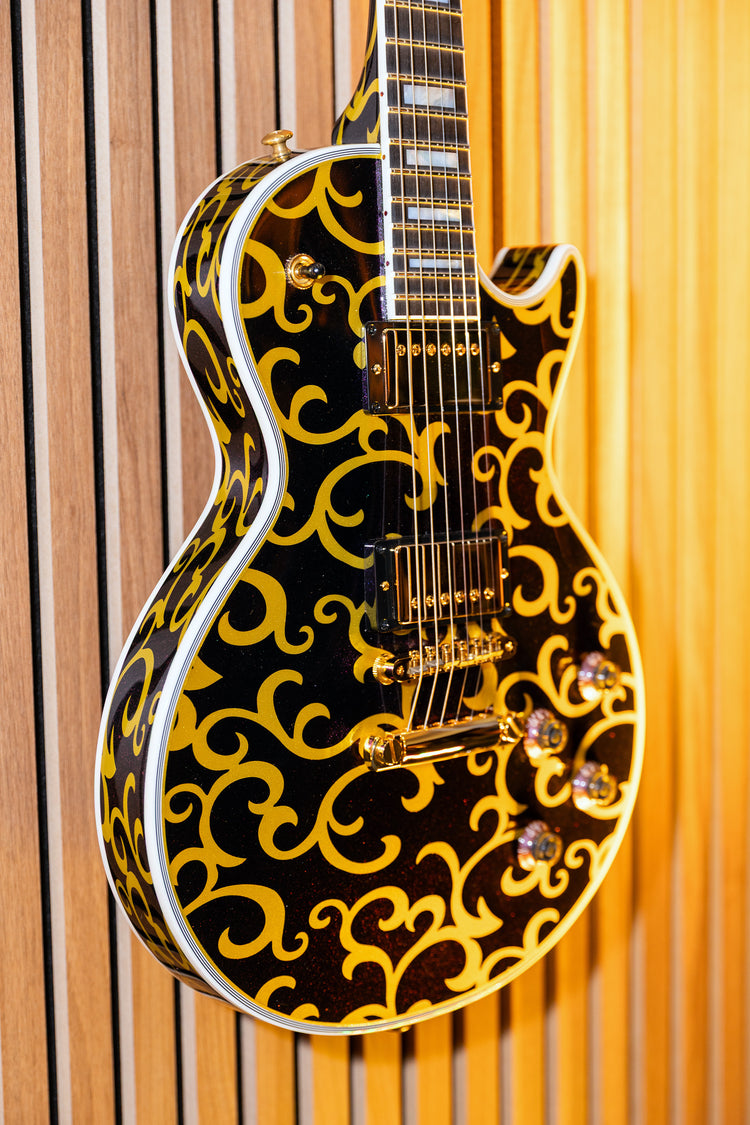
Compare L-R: left, Gibson 1992 rev2Rgo (Rgo dezigner template), 2022 Time Machine #80 1959 Reissue, $12,975. center, How to turn a Gibson 2014+ Custom Shop 1959 Les Paul `Burst` Reissue into a [rev2Rgo J+q 1992 futurewave] Time Machine at Tom Doyle Guitars; Time Machine #105, $11,750 in 2026. right, Tom Morgan Time Machine at NAMM 2026.
- 1992 J+q “Atomic Age” concept guitar,
executed by Gibson product engineer Darron Dubose,
presented at NAMM 2026. Includes J split coil neck humbucker (inverse TellMeMore for Turquoise by Fender), bowtie (q4J) over amoeba (j4Q) retro deco tuxedo non-flamenco (Q) pickguard; thru-string dulcimer bridge Alien Invasion Position One carveout by Ha, controls carveout by Jason.


From Ha's art history education module for Jason, on Francochina and French 20th century deco mod-den. The offset Gibson guitar Atomic Age, Jason's theme, designed by Rgo in 1992, is reviewed by Guitar World again 2026. The magazine touts it has that “blueprint lost in a locker for 50 years” look, which was what Jason insisted.
Ha ordered Jason to draw the back cutouts using his left hand; she retraced on his graph paper its mirror image using her left hand and a different pencil. Ha thought the kidneybean in the back was too close to the edge, he wanted to test the wood and left it that way. He made slight adjustments for a taller version of himself before sending the drawing to Gibson. She was too tired of Seymour Duncan's apparent memory hole, he wanted to be a spoiled spy for Gibson after Xmas. He chose this guitar to expand Ha's pickup combo into humbuckers, because he was excited for the next rig job, which would be Gibson on Gibson transposed and rig-split between his TellMeMore and her EinRouge, Seymour Duncan realigned and shoved in for Gibson's Lucille.
Jason wanted to skip Ha's Lucille and Jukebox pickups. She assigned him a Nukebox set of pickups instead, and that he had to consult Shoegazers on dissonance; the teenagers never finished their list for Gibson. Gibson was only leasing the designs because Gibson had no cashflow. Fender promised to ween Gibson off the lease program if they could gather the luthiers for the Rgo workorder, which was staggering at over a dozen unique guitars and several innovative pickups and amps. Quality supplies were incredibly expensive for art guitars. Thomas had a plan to speak to Middle Eastern investors for the entire Gibson packet; Ha was nervous.
- 1992 Q+j “Full Flame” SG Standard, presented at NAMM 2026
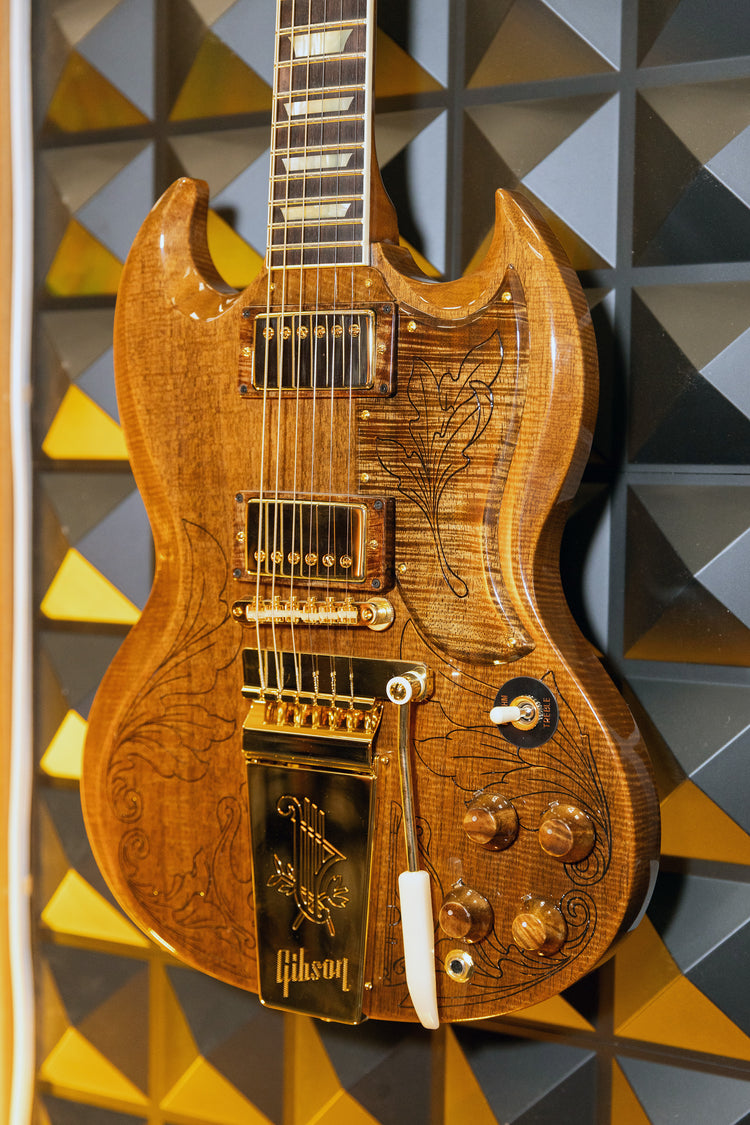
- J+q “Cosmic Stew” Les Paul Supreme, presented at NAMM 2026
- Gibson+j4Q 1993 “Ripped and Torn” EDS 1275 doubleneck, crafted by Garrett Brolund, presented at NAMM 2026
- 1992 Q+j “Western Floral” Explorer body Custom, presented at NAMM 2026
- 1992 Q+j “Foliage” Les Paul Florentine, crafted by Matt Sneddon, presented at NAMM 2026
II. Music Movement D. J #Archive Series Theodore
- “Quilted and Contoured” Theodore, crafted by Eric Holada
- J Archive Series Theodore, natural (standard)
estm.$5,000, Cream City Music - unfilfilled Les Paul guitars by Q Rgo

1980s Trapper Keeper, palm trees in late evening, similar to what Jason had in 1992.
These Rgo guitars were designed by Jason and Ha for Gibson, made by Gibson master luthiers practically 100 percent to specifications that Jason had written down on slim sheets of paper and tucked into a broken Trapper Keeper. Jason personally crafted the Plain Tulip in black (later called the Gibson Theodore). The vinyl folder was falling apart. Ha used a luthier's hammer to break the plastic rings and screwed on a tightly snapped together set of metal rings. Plus she gave him fresh cardstock paper duofold folders, three-hole punched without tangs, so he could have his drawings together without the fuss of metal and rusty tin.
On assignment from Thomas and artHaus, Jason studied the line of Gibson guitars that stretched across decades of popular music and Rock 'n Roll. Unlike Gretsch, which clung onto a rockabilly sensibility in their niche appeal, Gibson was like Fender as a massive, expansive, and top American guitarmaker. But Gibson was slower to innovate and just as likely to pay for a Bigsby tremelo bar and not do more about a Les Paul guitar. That observation was what Jason carried forth in how he selected what he did before he collaborated with Ha on Gibson Guitars. He spoke to her quite clearly about what he wanted to focus on as he pulled out a stack of blank sheets of paper to get to work on a packaged deal. The cutoff year was 1959. If anybody wants to know Gibson, he said, do not listen to music made on a Gibson after 1959. Everything after that was the Beatles, said Ha. Or Motown, she corrected herself. Elvis, Motown, Dianna Ross, he had to forget them and focus on the American electric instrument, not the star-crossed love life of Eric Clapton.
Jason honed in on what he believed was the height of Gibson influence in one of their only selling point, the 1957-1959 Les Paul guitar. Ha was going to divine why so. Jason was not there to hear the radio back then. Ha had a taste of boomboxes. But even as somebody only four years younger, all Jason had was the Sony Walkman. How was he supposed to discern any merit from live performance as opposed everything polished from inside a studio? He studied concert footage on video, like Ha told him to. He was mesmerized by the singers of the 1950s and lost track of what to do about an electric guitar company. Until he heard Les Paul on the man's own guitar. He could hear every corporate pressure to conform, every personal innovation and flash of personality—technically. He felt like an idiot savant and shook it off. He did not care how Les Paul played the guitar, he could hear the tones of the wood, the metals, the electric buzzing, even the thereness of the venue as an acoustic surrounding. The reverb on the guitar made it that easier to listen to than a singer on a microphone. Were amps the difference? Jason knew Ha was like Les Paul and told her, Did you know you have the same birthday in the year as Les Paul? You and your speaker-amps, only Geminis want it both ways at the same time.
The assembly of the folios aligned with the design decisions, but their purchase by Gibson were mixed reasons. According to Gibson reps, Art shows still life, remember music with musical instruments. Jason never cared for the gallery reason for a luthier's product. He could have handed over half a bolt of fabric and a pair of leather shoes and say that was what the luthier had prepared for the musician visiting Gibson's Nashville factory.
Where is your Custom Shop?! My Chinese girlfriend (stagename Wind Song, a running joke about Rgo dressed up by artHaus) has hired expensive tailors, she is prepping the musicians now. Where are the master luthiers, where are the artists?! Special Les Paul guitars have to be ready, the musicians are so high class! My girlfriend is spending so much money, I need those guitars to be more than souvenir quality. I need couture museum quality guitars! The Fender adult chaperone told him he was being a prima donna and to spend some time inside the factory before sneaking away to the custom shop, to practice his speaking skills so that he could practice his listening skills with the Gibson master artisans. Ha handed to him an invisible baton, which was all he was going to get from Ha the Gibson guest rep saleswoman, for his effort to clarify Art Moment: effort.
Gibson could not afford the craftwork phase of Rgo guitars without significant financial backing by Ha and Fender. Thomas got Ha to accept, Gibson artisans will be rendering into guitars at the workshop your blueprints and specifications like sheetmusic, they are professionals, so do not let Jason make any mistakes when you compose philosophy into his own art ideas; make sure he has tastes. Ohhhh, the other teacher was encouraging, Ha guessed: make sure Jason has true ideas. If that happened, Thomas could withdraw his seed money, and what was on the table should be financially right for Gibson. Fender put his seed money back into Rgo, they were certain Jason's portfolio was going to be sold for a good price. Fender took the lead in price negotiations, Thomas was $4 million underestimating. The price for the two large packets together started at $14 million, Gibson was out of cash for bidding on Ha's even larger, less colorful and more technically challenging work order that might require an even bigger custom shop.
For the first one, Gibson was approached by Thomas that Rgo had a design packet ready with about three different categories of folios, all leaning on nostalgia and de-emphasizing technological innovation. It would be a display of a strong art movement that Gibson was involved with and ought to be proud to highlight. Jason researched Les Paul. By the time he went to Ha to plan the packet, she scooted the needle on the record back by twice the length of time, from the 1950s to French-observed American 19th century fin de siècle climate before World War I. He did not know what that meant, how culture had possibly went from transcontinental industrialization to a second rise of bourgeoisie decadence that rivaled post-Napoleonic nationalism. He realized where progressivism came from: less nostalgic and old-world, propelled by the difference powered machinery brought to the mechanics of producing and owning artworks but also the need to balance with vital colors and forms, experimental playfulness in the spectrum between geometry and verisimilitude, the whole range from left to right.
Ha was onto progressivism, becusse that was what Jason wanted to pursue in Metal music and guitar. She catered her tutoring to his fascination. After grasping the line of progressivism, he formulated his statements on their themes. Jason's thesis popped air out of the bag of froo-froo art. Large deco towers, poodle skirts, institutional square labyrinths, seedy tenament residential corners, neon neoprene on the beach. Ha wanted him to be certain of what he was going to display, whether he was displeasing Gibson or projecting anything contrary and fantastical that was not true of Gibson. If you criticize Gibson, it must have been something Gibson did, not something only Fender was doing and you wish Fender was not the reactionary one, or Ibanez was not the Blues Rock one, or Yamaha picked up all that American jazz and held it together for Funk and R&B. If they were interchangeable soldiers, we could mold them any time, to lie to them or to lie about them. They chose to be distictive from each other, basically to compete for accolades. If it involved lying about the other guy, and patrons and customers only want to see art, is there anywhere ugliness can hide in art? So did you want Gibson to take a second gander at Les Paul and say their investment is over-rated? Nein! Jason wanted to criticize Gibson because it was not as plain as Les Paul the luthier, who should have worked for Fender and died in contented obscurity. And how to criticize and still crank out something beautiful, patrons should already know there is no customizing a Les Paul guitar: it is meant to sound the same, any Les Paul guitar, so you can make it wall art superficially colorful and different one with the other next to it a decade later.
The lithmus test for Jason's musical sensibility. Ha has a poem from English Post-Romantic era, circa Oscar Wilde. It is set to music, and a Les Paul guitar is involved.
What Jason meant and subtly impressed, without disrespecting Les Paul or Gibson, was Gibson's investment was over; there was nothing new with a Les Paul, it was an end-of-life squeeze of the last lemon drops. He did not want nostalgia but to push back disruptive hybrids that did not belong to or fit with 90s music. She asked him, do you regret I have no alternative to the Yamaha, and it is quite different from a clasical concert guitar; it is a practice guitar for compulsories and noodling, not for flashy, stagey virtuosity with big amplification? Here in America, virtuosity has shifted to electric guitar. Parlor music was Jason's cup of tea. Far away, if we were at Woodstock way in the back, Ha said to him, we can hear the music when we get up in the cold morning and stand in dingy blankets and not shave and shower for a few more days. Is an art guitar going to make music for the multitude? Jason knew his way around his own people: Some people get to take home a razor, the rich people pity them. The rich people are the ones who pass out the razors because they have a Gibson Les Paul at home, it is personal.
Ha said it, An electric guitar is not a field instrument to march with, it is pleasant when the people are already gathered. Since when is an electric guitar a durable good? The more organic, the easier it is to maintain, actually the more durable it is, not in indestructability but in fittedness; it fits the envronment long-term because it is not too distorted in form ingredients it is made of from the environment where it is from. Rock, it serves millions for thousands of years. Wood, serves a few hundred for one hundred years. Tree or statue? You leave a wood carving outside in the rain, you are saying the Europeans do not belong in America with our hawks and ravens and box turtles. Jason meant he could predict Fender's comeback in 90s music.
The second one (includes Vintage Radio guitar) was sold to Gibson first; they wanted to invest in Rgo to see if Thomas' plan to focus on customization would help Gibson's business. Jason did not want to limit the first packet to Gibson but he could not fathom why any other guitarmaker would want exhibition-style playable art guitars—not Ibanez or Fender, unless it was a non-American guitar company. He liked the idea, he wondered why business managers were dragging their feet on a sticker price. Thomas informed Jason: regarding Gibson, first there is a sticker price, then there is the ticket price of the gallery showing that Rgo has to pay for. Or what? Or a Gibson vice-president of product stares at Thomas and blinks a few times, all cozy cozy, and a Fender rep walks up and goes, Hey, guys, sold anything today? Get out there out front, there are musicians and visual artists and art directors and petformance artists who don't know anything about art guitar! Your job is to take the circus and show off you sound better than all the rest, any time. They are circus, we are culture. What?! That was Fender's attitude every time word got around Rgo needed cultural investment; Rgo was a junior circus, the teenagers had rigid structure from schooling but did not know flexibility in management.