david+ha
prēszenting...
Rgo 1992-1993 unique prototype, sample, commemorative, and one-off guitars.
Each is one guitar only, except production runs and approved speavants not owned by Rgo
cited afterwards. This list is lotsa incomplete.

![]()
- headless Q examiner
- Gretsch no. 1 (Q Rgo prototype)
- Gretsch no. 2 (R Rgo colorific)
- Gretsch no. 3 (R Rgo turquoise dot)
- PRS I (R Rgo)
- Gretsch no. 4 (J Rgo diamond double rings)
- Rgo's R electric textured carbonfiber headless Q examiner, corrected and signed by Ha of Rgo in 1992. Ha forgot the luthier's name, he was perhaps 29 years old at the time.
estm.unsellable (originally $800)
- Ha's Gretsch prototype; Q Rgo 1992 Gretsch no. 1 in Candy Apple Red.[1]
estm.$19,000 (vice-president family member of Gretsch paid $7,000 in 1992 x2.24 = $15,680 in 2025 adjusted for inflation).
- Thomas-modded Gretsch prototype and personal guitar; R Rgo 1992-93 Gretsch no. 2, hand-painted by Thomas (Ha Pantone color __), signed by Ha; Thomas joins Rgo.
estm.$16,000-$19,000.
- R Rgo 1993 Gretsch no. 3, 110th Anniversary “diamond model” G6118 hollow body semi-electric factory custom sample w/ artisans' proofs,
signed by Thomas referencing his military rank, redesigned tailpiece by Ha with less metal (not a Bigsby, no tremelo bar[3]) 110 binary=6.
Series gift for Ha's birthday, and all ‘diamond’ in series in perpetuity, made in Japan.


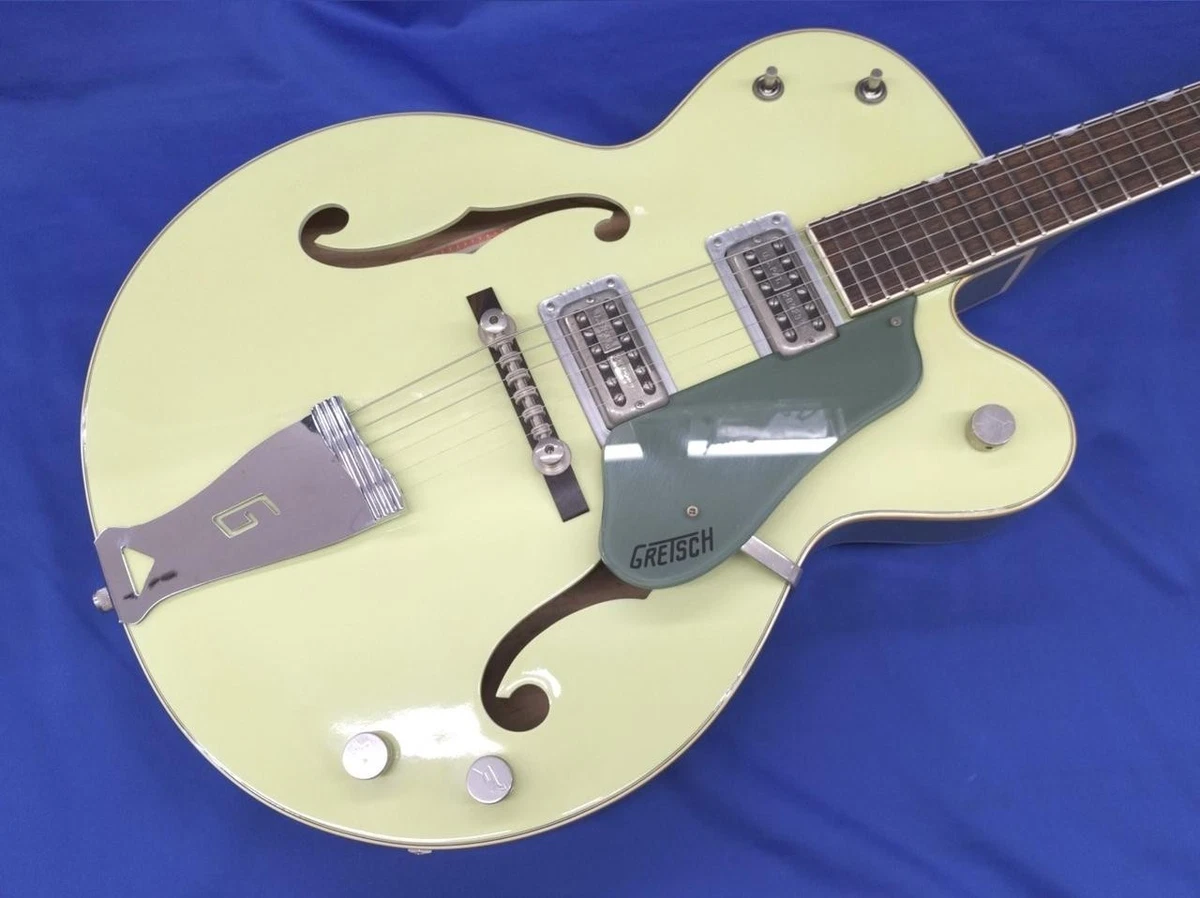
 I. Jason visited a Gretsch factory. He colored in chartreuse on a paper dot, for the back of one of the string winders. Factory workers chose the other color, which is peach, representing their headquarters in Georgia. It might seem like a strange marker to customers; it is done on purpose.
II. Thomas tucked away the first baggy like that[2] when it was fresh from the Gretsch factory. The Gretsch artisan who worked on the diamond redesign said tracing the sparkle spray old-school on paper, instead of using CADCAM or the digital library, was enjoyably challenging, because a negative template had to be made for the machine press. Doing the lettering in all-capitals by hand on the template was part of the fun.
There are three facets to the diamond, representing Rgo Trio. Like the old design, the spray goes in all directions, which is repeated like the NATO compass rose in a different Rgo motif; Thomas liked that observation. The redone diamond is a nod to Ha's G.I. vintage Jabel ring, because that is what happened to the ring: its sizing had broken in the middle on the “band” (shank), the diamonds were replaced and upgraded to match each other, fine firey diamonds selected by a Vietnamese jeweler in Arlington, Va. in 1990-91.
A commemorative scrollhead badge is printed every year on the anniversary of Ha's birth (June 9th), with serial number indicating her age. The badge above was produced in 2003 and refers to Ha's 28th birthday in 2003. At a good time at the Gretsch factory on that day, workers pause work and meditate for a few minutes, were Rgo's request to employees. Jason was practicing Buddhism.
III. Gretsch introduced a simpler tailpiece[3] into some of their guitars that did not focus on tremolo, based on Ha's advice. Over time, they can even reach out to guitarists who do not use the beautiful signature Gretsch pickguard that covered half of an f-hole. Without the Bigsby hinge, the new suspension tailpiece was lighter, more responsive, and looked like it belonged more on a mandolin than a barn door. Paying less for the Bigsby tailpiece license by cutting down its use across the products line was one of the most noticeable ways Gretsch had to reduce cost to survive as an independent guitar-making company.
In 2026 Gretsch offered non-Bigsby tailpieces: Electromatic (G cutout), Synchromatic, Chromatic, and Chromatic II, two of which were advised by Ha, in particular the trademarked Chromatic. The trademark 'Electromatic' was restyled into friendlier verbiage and not mentioned in newer models by Gretsch.
IV. For more information of Rgo's partnership with Gretsch, see the Rgo+Gretsch page. Rgo introduced updates for the Falcon (collab with Jason), the Penguin (collab with Ha), Cadillac features (offered and rejected with Ha, reoffered and accepted through Jason and Thomas), marketing the Jet, bold coloring and even more sparkly and crackling body texture. Gretsch's revitalization was encouraging: their old arrow circle-G logo from the Gretsch family that they added onto several guitar models. Rgo did not take home any of those new offerings.
A one-off comment by Ha that belongs in the custom shop only. Yet, there is that cat eye f-hole again. Can you guess what year Gretsch catalog[4] the above Synchromatic Archtop came from? Ha did mention archtop, to perhaps get Gretsch to be more closely associated with acoustic guitars. RichyRich got his way with shell-like inlays on the fretted neck even if Gretsch is known for their stylish off to the side “thumb dots”. Ha joked to Thomas on how the marketing might go. He liked her phrasing, which came out similar by Gretsch. Voila!Our “Squeezebox” capacitor adds smooth vintage tone while the all-new treble bleed circuit lets your guitar retain all of its tasty clarity when rolling the volume control down.
Speavants, __ percent, made in Japan:
+ G6618-MG Martin Gore Anniversary™ Center Block with G-Cutout Tailpiece
+ G6118T Players Edition Anniversary™ Hollow Body with String-Thru Bigsby®
+ G6118T-140 Limited Edition 140th Double Platinum Anniversary™ with String-Thru Bigsby®, for Jason of Rgo; see Jason's diamond double rings (J speavant approved by R)
+ G6118T-60 Vintage Select Edition '60 Anniversary™ Hollow Body with Bigsby®
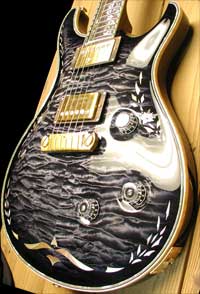
- R Rgo 1992-1993 Silver Laurel Roman Dragon-Scale PRS I (Paul Reed Smith), green Tiger undertexture solidbody electric guitar w/ genuine silver inlays on body's top, edged in real gold; Dragon I/II by Pearl Works.
No photo available of R Rgo's PRS I. The initial investment for long-term success of PRS as a luthier and guitar manufacturer. Significant costs?
I. While not Thomas's Silver Laurel Roman on green Tiger, the above guitar was donated to the Smithsonian's National Museum of American History in DC; it is done in green Bamboo designer undertexture.
Thomas had gone up to Annapolis to encourage Mr Smith to not only finish the intricate dragon motif inlay but to make the guitar an anniversary guitar. He picked out each material for the inlay and designated them: turquoise for Jason, mother-of-pearl for Ha (she had also a gold and natural pearl ring with two diamonds), ebony for his wife (?), abalone for himself, Ha forgot the rest of the set. Batwings for the dragon, real silver inlay of a laurel wreath stencil along the swoop of the belly and all the way around on both sides, more inlays for the edging. Over the years Smith would continue to incorporate even more Rgo designs into PRS guitars. Except the inverse did not happen in 1993.
Thomas ordered Jason to use a PRS headstock for Skeletor, “The head is going to be a PRS”. Jason was miffed. What is a headstock? Is that a factory word? A word Ha did not teach Jason. Instead, Jason drew a stylized version of Ha's lips (Ha has a cool birthmark there). Either Jason or PRS recut Skeletor's scrollhead shape, then Jason drew a template for painting the emblem of Ha's left ear on it (Ha has a cool birthmark there). Well, okay, the head was going to be an Rgo.
Thomas and Ha had the “periscope” silly tease. __
- 200+ individual pieces of natural inlays for the fret board; financing PW, consultancy for PRS
- all-around body top inlays requiring a superior binding specified by Rgo; consultancy w/ Chinese acoustic lutherie 50 percent
- infusion of development funding and shielded forex for continued reliance on Brazilian wood; free, courtesy of Pentagon and State Dept
- specie employment expansion, silver and gold, for PW; courtesy of State Dept and Treasury
- funding for ramp-up factory capacity for anniversary benchmarks, new category Private Stock, later categories such as Student Edition; consultancy w/ Joseph __ 50 percent
- coordination with the people's trust, i.e., museum
- future stakeholding to grow trees in Montana etc.
- co-development and special marking Rgo top humbucker on select PRS
2026 estm.$75,000+
I. While not Thomas's Silver Laurel Roman on green Tiger, the above guitar was donated to the Smithsonian's National Museum of American History in DC; it is done in green Bamboo designer undertexture.
Thomas had gone up to Annapolis to encourage Mr Smith to not only finish the intricate dragon motif inlay but to make the guitar an anniversary guitar. He picked out each material for the inlay and designated them: turquoise for Jason, mother-of-pearl for Ha (she had also a gold and natural pearl ring with two diamonds), ebony for his wife (?), abalone for himself, Ha forgot the rest of the set. Batwings for the dragon, real silver inlay of a laurel wreath stencil along the swoop of the belly and all the way around on both sides, more inlays for the edging. Over the years Smith would continue to incorporate even more Rgo designs into PRS guitars. Except the inverse did not happen in 1993.
Thomas ordered Jason to use a PRS headstock for Skeletor, “The head is going to be a PRS”. Jason was miffed. What is a headstock? Is that a factory word? A word Ha did not teach Jason. Instead, Jason drew a stylized version of Ha's lips (Ha has a cool birthmark there). Either Jason or PRS recut Skeletor's scrollhead shape, then Jason drew a template for painting the emblem of Ha's left ear on it (Ha has a cool birthmark there). Well, okay, the head was going to be an Rgo.
Thomas and Ha had the “periscope” silly tease. __